
Removal & correction
Tattoo Removal: How Lift Saline Removal and Laser Work Together
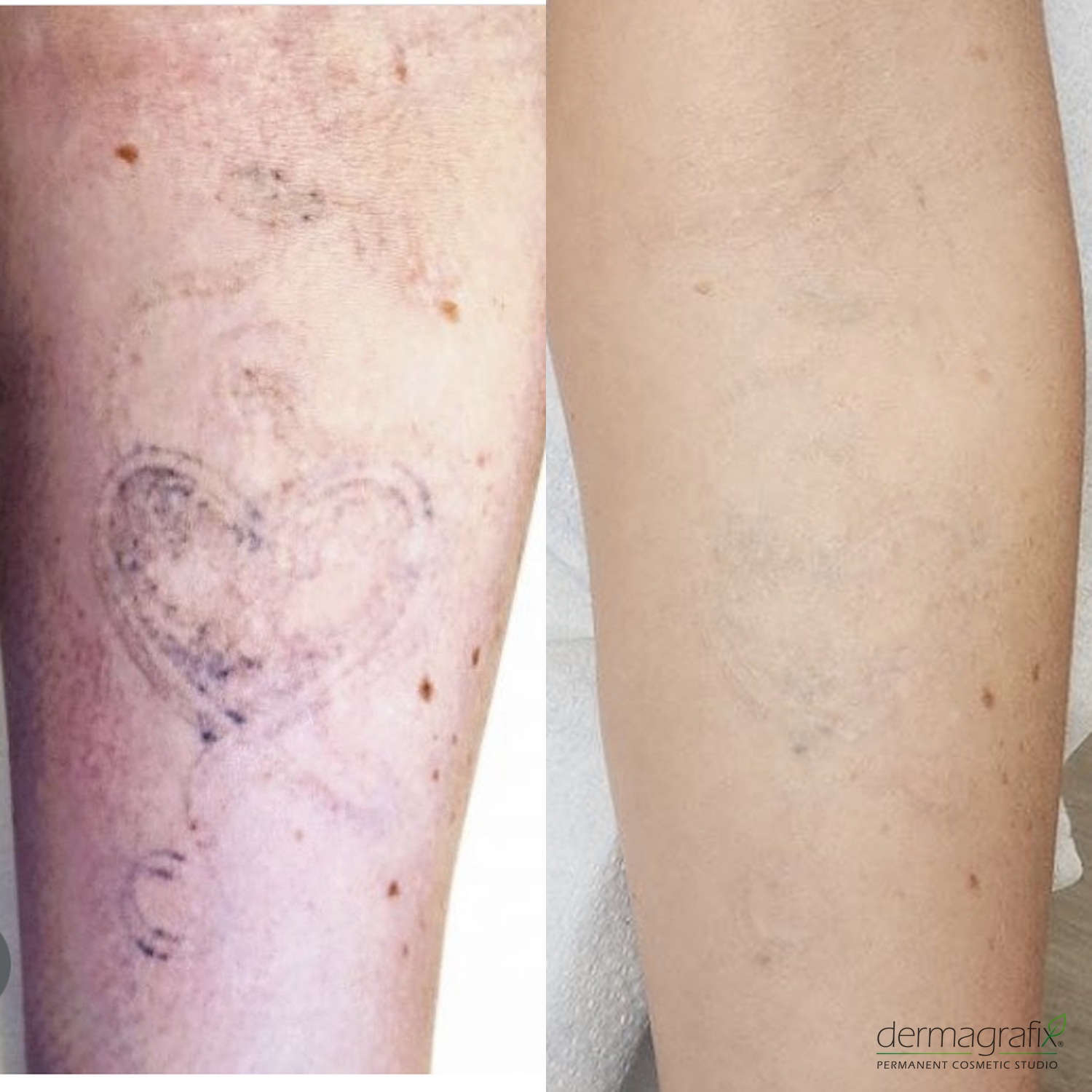
Removal is rarely the whole story. Most people who come to us for it are trying to get somewhere else — a brow they can live with, a hairline that reads naturally, skin that looks like skin again. Understanding the two tools we use, and where each one belongs, makes the plan far easier to follow.
What Lift saline removal is
Lift is a saline-based removal method. A tattoo machine is used to open the area in the same controlled way a tattoo is placed, and a saline solution is worked into the skin. Through osmosis, the solution draws moisture and pigment particles upward toward the surface, where they become part of the scab that forms. When the scab releases naturally, it takes a portion of the pigment with it.
Why it works — and who it suits
Because saline is non-selective, it lifts color regardless of shade. That matters enormously for permanent makeup and skin-tone work: it does not care whether a pigment is warm, cool, or white, and it does not chemically alter titanium dioxide the way a laser does. It is our usual first choice for brows, lip blush, eyeliner, small SMP corrections, and any area where a lighter starting canvas is needed before new work. It is also gentler on the surrounding melanin, which makes it a safer opening move in deeper skin tones.
The trade-off is pace. Saline removal is a series of sessions spaced roughly six to eight weeks apart, because the skin has to fully heal before it can give up more. Density, age of the work, depth, and how the pigment was originally placed all influence how many rounds are needed.
When laser is the right tool
Laser works differently: pulses of light are absorbed by specific pigment colors and shatter the particles into fragments small enough for your immune system to carry away. For dense body ink and stubborn dark carbon-based pigment, it clears volume far faster than saline can. It is color-selective, so some shades respond beautifully and others barely respond at all — and pigments containing titanium dioxide can darken on contact, which is why we assess what is actually in the skin before recommending it.
Using both: Lift after laser
The two methods are complements, not rivals. Laser shatters pigment, but not every fragment gets cleared — plenty of it lingers as a stubborn haze that further laser passes stop improving. A saline session afterward is an effective way to gather those shattered particles and draw them out through the surface. For many cases, laser first for volume and Lift afterward for the residue is the fastest honest route to a clean canvas.
What often comes after removal
Removal can leave its own marks. Laser in particular can affect melanin, leaving an area lighter than the skin around it once everything has settled. Where that happens and the skin has fully stabilized, skin re-pigmentation can restore an even tone.
For permanent makeup and scalp micropigmentation, the goal is usually correction rather than a blank slate. Once old work has been lightened enough to stop dictating the outcome, we rebuild — natural brows, liner, and lip color in the right shape and tone, or SMP re-placed at the correct depth, density, and hairline.
Realistic expectations
No one can promise a specific number of sessions at a first look. What we can promise is an honest assessment of what is in your skin, which tool suits it, and roughly how long the sequence will take — and that we will not shortcut it by tattooing over a problem that has not been resolved.
Read more about tattoo lightening and removal and permanent makeup, or see healed results from real clients.
Pennsylvania
Our Doylestown studio welcomes clients from Bucks County, Montgomery County, Philadelphia and the greater Philadelphia area. See restorative tattooing and SMP near Philadelphia.
Florida
Our Stuart, FL studio welcomes clients from the Treasure Coast and Palm Beach coast, including Palm City, Jensen Beach, Port St. Lucie, Tradition, Hobe Sound, Jupiter, Tequesta and Palm Beach. See restorative tattooing and SMP on the Treasure Coast.