
Breast restoration
Mastectomy Tattooing — Comfort, Realism, and Celebration
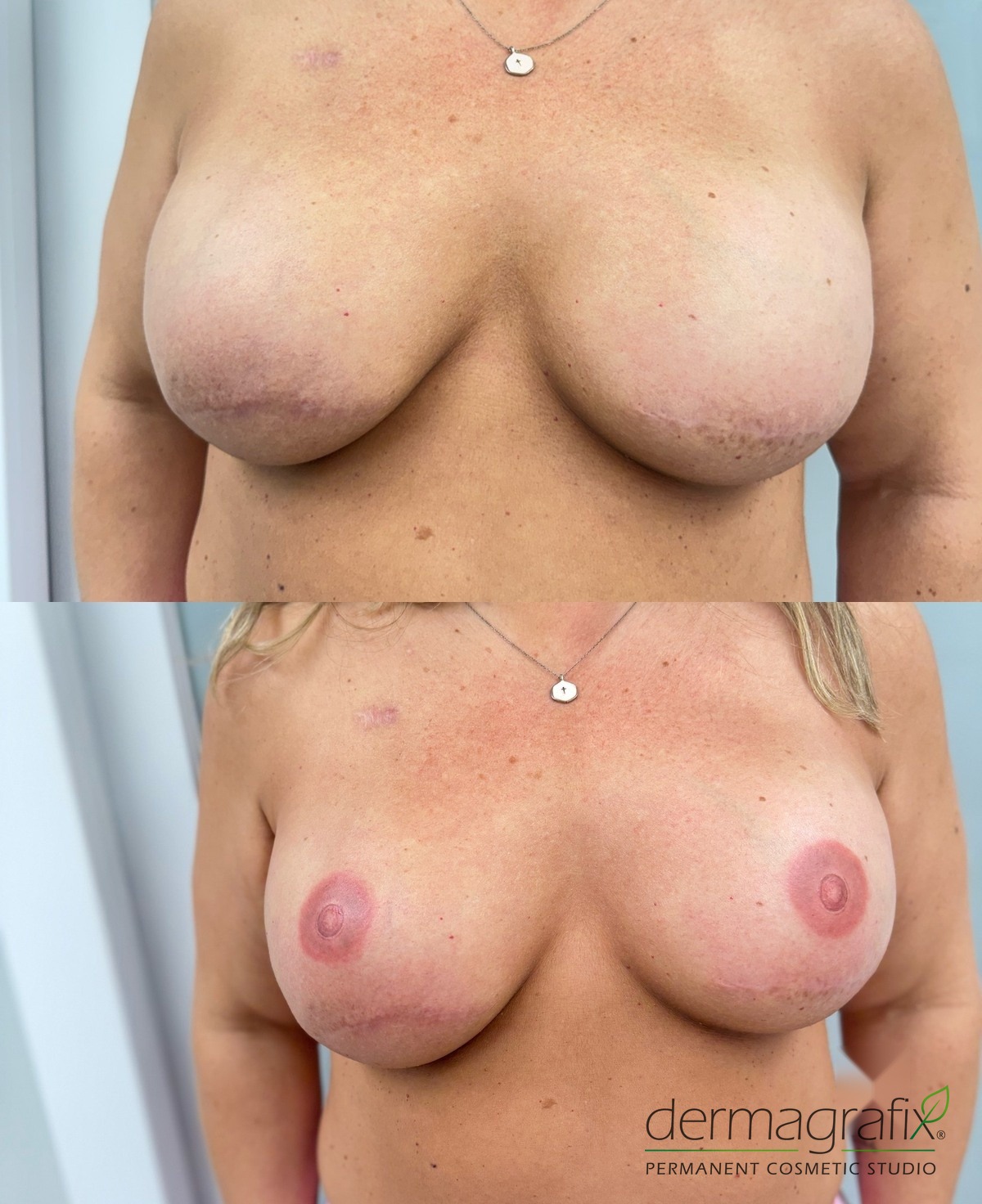
For most clients, areola restoration is the last appointment in a very long sequence. Everything before it was necessary. This one is chosen. We take that difference seriously, and we plan the day around it.
A celebration, not another procedure
Surgery, treatment, and recovery are things that happen to you. This is something you decide on, design with us, and walk out with. Clients often describe it as the moment the chapter closed. The room is quiet, unhurried, and yours — nothing about it should feel like a clinic visit.
Your comfort sets the pace
Reconstructed tissue can be numb in places, unexpectedly sensitive in others, and tight along incision lines. We work with what your body is telling us: breaks whenever you want them, positioning adjusted so nothing pulls, privacy respected at every step, and appropriate comfort measures used throughout. Nothing is rushed to finish in one sitting. If a session should end early, it ends early.
How realism is built
There is no raised tissue to work with, so the impression of depth has to be created with color. Custom-blended tones are matched to your skin, then layered with dimensional shading and highlight so the areola reads as round and projected rather than printed on. Texture detail at the edge keeps the transition soft, the way real skin behaves rather than a hard outline.
Placement, symmetry, and mapping
Before any color is placed, we map position and size with you, upright and in a mirror, because that is how you will see it. Bilateral work is designed as a matched pair. Unilateral work is matched to your remaining side in tone, size, and character. Scars and reconstruction shape the plan — placement is chosen to work with them, and in some cases scar softening comes first.
Timing and sessions
We wait until reconstruction has fully healed and your surgeon has cleared you. Most clients need more than one session: the first establishes shape and base tone, and a follow-up refines depth and color once everything has settled. Healed color softens from what you see on the day, which is why the final result is judged weeks later, not at the end of the appointment.
Read more about areola and nipple restoration, or see healed results from real clients.
Pennsylvania
Our Doylestown studio welcomes clients from Bucks County, Montgomery County, Philadelphia and the greater Philadelphia area. See restorative tattooing and SMP near Philadelphia.
Florida
Our Stuart, FL studio welcomes clients from the Treasure Coast and Palm Beach coast, including Palm City, Jensen Beach, Port St. Lucie, Tradition, Hobe Sound, Jupiter, Tequesta and Palm Beach. See restorative tattooing and SMP on the Treasure Coast.