Education
DIY Microneedling: Collagen Timelines, Over-Treatment, and Why It Ruins Cosmetic Tattoos and SMP
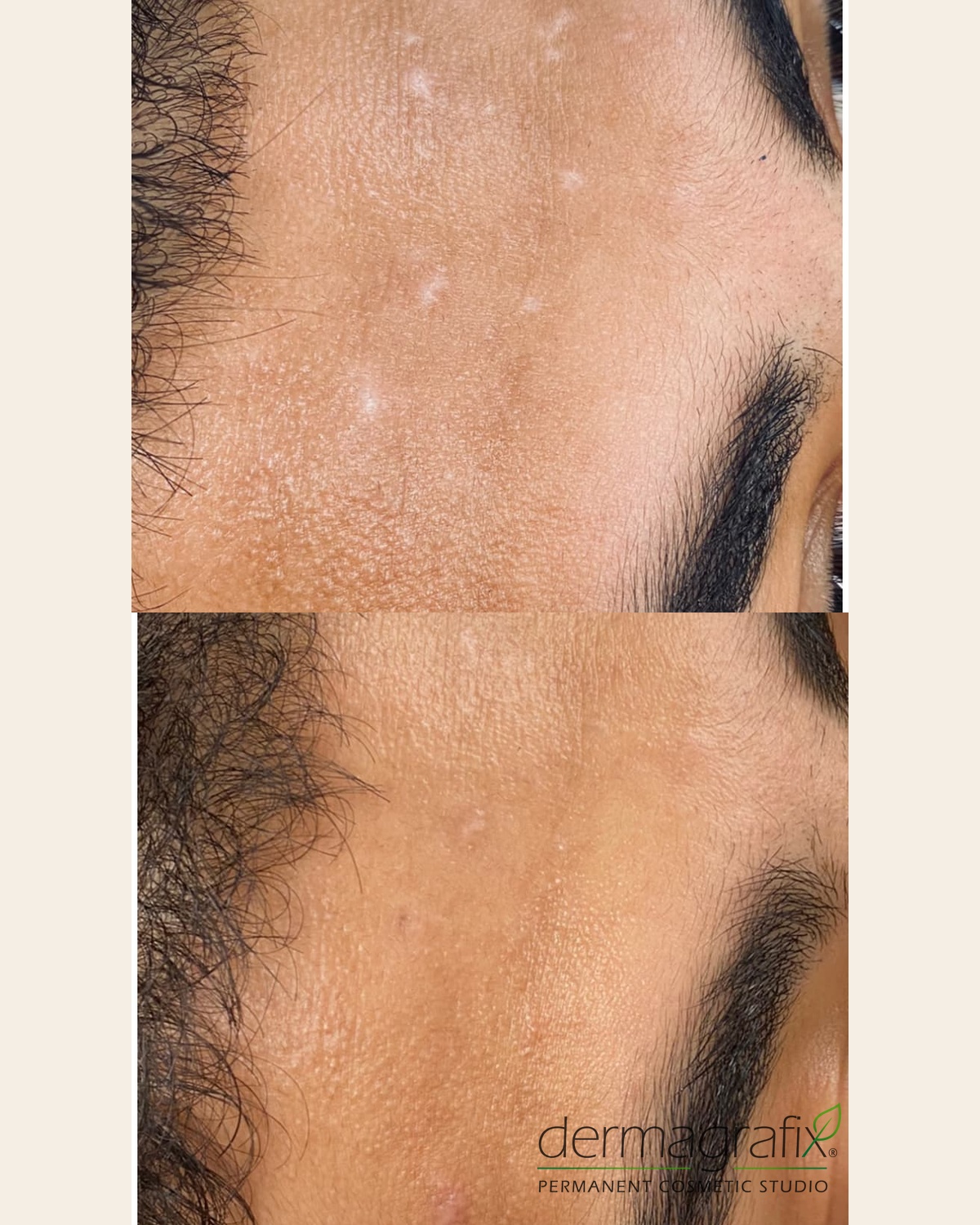
At-home microneedling has become one of the most common things clients ask us about, and one of the most common reasons we end up repairing work. The device itself is not the villain. The trouble is almost always the same three things: treating too often, expecting results on a timeline skin cannot keep, and needling over tattooed skin.
What needling is actually good for
Used well, needling is a remodeling tool. It rebuilds and reorganizes tissue, so it shines where the problem is the structure of the skin itself:
- Depressed and atrophic scars — acne scarring, surgical indents, and pitted texture, where new collagen lifts the floor of the scar toward the surrounding skin.
- Stretch marks — older white striae respond slowly but genuinely, as the thin, collagen-poor bands thicken.
- Skin laxity and crepey texture — a gradual firming and thickening of the dermis.
- Burn scars — helping release trapped pigment and soften and relax contracted tissue so it moves more freely.
- Hair-bearing scalp — improved circulation and growth-factor activity around the follicle.
It is just as important to be clear about what it is not. Needling does not fill a hollow the way a dermal filler does, and it does not work on filler's timeline — filler is immediate, needling is months of quiet rebuilding. It does not tighten to the degree of a facelift, and it will not remove loose or excess skin, though it does help skin look and behave better. If your goal is volume today or the removal of redundant skin, needling is the wrong tool, and we will tell you so at your consultation.
Collagen works on a slow clock
Needling creates thousands of controlled micro-injuries. Your body answers in stages, and those stages are not negotiable:
- Days 1–3 — inflammation. Redness, warmth, tightness. Growth factors flood in. Nothing has been built yet.
- Days 3–21 — proliferation. New capillaries and a soft, immature collagen (type III) fill the space. Skin can look plumper here, which people mistake for the final result.
- Week 3 to month 12 — remodeling. That soft collagen slowly converts to strong, organized type I collagen. This is the part that softens a scar, refines texture, or improves a stretch mark — and it is measured in months, not days.
Practically: expect a first honest look at around eight weeks per session, real change after a series of three to six sessions spaced eight to sixteen weeks apart, and continued improvement for six to twelve months after your last one. That spacing is deliberate — it lets remodeling finish before the skin is asked to heal again. The longer end of the range belongs to body areas, which repair more slowly than the face, and to melanin-rich skin, where extra healing time lowers the risk of pigment changes. For scars and stretch marks, the full picture often takes a year. For hair, the stimulation is a circulation-and-growth-factor effect on the follicle, and hair grows on its own schedule — three to six months before anything is visible in the mirror.
Over-treatment is the most common DIY mistake
If you needle again before remodeling has finished, you interrupt the build and restart inflammation. Do that repeatedly and you are no longer remodeling — you are keeping skin in a chronic wound state. What that looks like in real life: persistent redness and sensitivity, a shiny or tight quality to the skin, enlarged-looking pores, tracks and fine scarring in the direction the device was dragged, post-inflammatory hyperpigmentation (especially in melanin-rich skin), and in stubborn cases fibrotic, hardened tissue that is harder to treat than what you started with.
Weekly at-home needling is not a shortcut to faster collagen. It is the reliable way to get less of it. Add infection risk from a device cleaned at a bathroom sink, and products pushed into open channels that were never meant to go below the skin surface — vitamin C serums, essential oils, and anything with fragrance can cause granulomas.
Never needle over permanent makeup or scalp micropigmentation
This is the one that costs people their results. Your cosmetic tattoo or SMP is pigment held in the upper dermis. Needling through it does three things at once: it fractures and mobilizes the pigment particles, it opens a channel for some of that pigment to escape upward, and it recruits immune cells that carry the rest away.
The result is not an even fade. It is patchy loss, blurred and spread edges where crisp hair strokes or SMP dots used to be, and unpredictable color shifts as the warm and cool components of a pigment break down at different rates. On a scalp, individual impressions smudge into a grey haze. On brows, strokes turn into a soft blur. And because the pigment is now scattered rather than sitting in a clean layer, correction is genuinely harder — often saline lightening first, then rebuilding.
The same caution applies to strong at-home acids, retinoid over-use, and aggressive exfoliation directly over tattooed areas. If you want facial needling and you have brows, liner, lip blush, or SMP, the treated area must be masked off and avoided — a professional will do that for you. If you have needled over your work already, don't panic; come in and let us assess it before anyone adds more pigment. You can read more in our article on saline lightening and laser.
Rollers versus microchanneling devices
A dermaroller enters the skin at an angle and leaves at an angle, so every needle carves a small tear rather than a clean channel. Rolled over an area repeatedly, those tears become the micro-tracking we see on long-term roller users. Depth is whatever pressure your hand happened to apply, the needles dull quickly, and the head cannot truly be sterilized between uses.
A vertical microchanneling device — the type we use — stamps straight in and straight out at a set depth and speed, with a sterile single-use tip. The channel closes cleanly, the injury is uniform, and depth is adjusted deliberately for a forehead versus an abdomen versus a scar. That control is the entire difference between remodeling and tearing, and it is why our ink-less needling and skin retexturing work is done with channeling rather than rolling.
Where RF microneedling fits
Radiofrequency microneedling adds heat. Insulated needles deliver energy at depth, causing immediate collagen contraction plus a deeper wound-healing response than needling alone. Done well, it tightens laxity, improves acne scarring and pore size, and reaches tissue planes a manual device cannot.
The trade-offs are real. Heat carries a risk of burns and tracking, longer downtime, and in some patients fat atrophy — a hollowing along the treated area that can be permanent. In deeper skin tones, heat is a known trigger for post-inflammatory hyperpigmentation, which is why conservative settings and test areas matter.
Some candidates are simply better served without RF: anyone with active inflammatory or autoimmune skin activity, a history of keloids, active infection or acne flare, recent isotretinoin, pregnancy, an implanted pacemaker or defibrillator, permanent metallic implants or fillers in the treatment zone, thin or already-atrophic tissue, and anyone whose goal is texture or scar work rather than tightening — where plain microchanneling gets there with far less risk. Cosmetic tattoo and SMP areas are off-limits for RF for the same pigment reasons above, with heat added on top.
A word on red light therapy
Red and near-infrared light is a gentle, non-injury companion to needling. It works at the level of the mitochondria, supporting cellular energy, calming inflammation, and easing skin through the healing phase. It does not create the wound response that drives remodeling — it supports the one you already have — and unlike needling it is safe over healed cosmetic tattoos. It is worth a full article of its own, and we will write one; for now, think of it as recovery support, not a treatment on its own.
One important caution: RLT is not for skin that tends to hyperpigment, because light and warmth can stimulate darkening. If you are doing this at home and are not sure of both the full benefits and the repercussions for your skin, don't use it — ask a professional first. See what makes hyperpigmentation worse.
If you want needling done properly
A consultation is where we look at your skin, your history, any tattooed areas, and decide honestly what will help — and how often. Sometimes the most useful advice we give is to treat less and wait longer.
This article is client education, not medical advice. For diagnosis or treatment of a skin condition, please see your dermatologist.
Read more about inkless scar retexturing, or see healed results from real clients.
Pennsylvania
Our Doylestown studio welcomes clients from Bucks County, Montgomery County, Philadelphia and the greater Philadelphia area. See restorative tattooing and SMP near Philadelphia.
Florida
Our Stuart, FL studio welcomes clients from the Treasure Coast and Palm Beach coast, including Palm City, Jensen Beach, Port St. Lucie, Tradition, Hobe Sound, Jupiter, Tequesta and Palm Beach. See restorative tattooing and SMP on the Treasure Coast.