
Pigment loss
Vitiligo Camouflage: What Cover-Up Tattooing Can and Can't Do
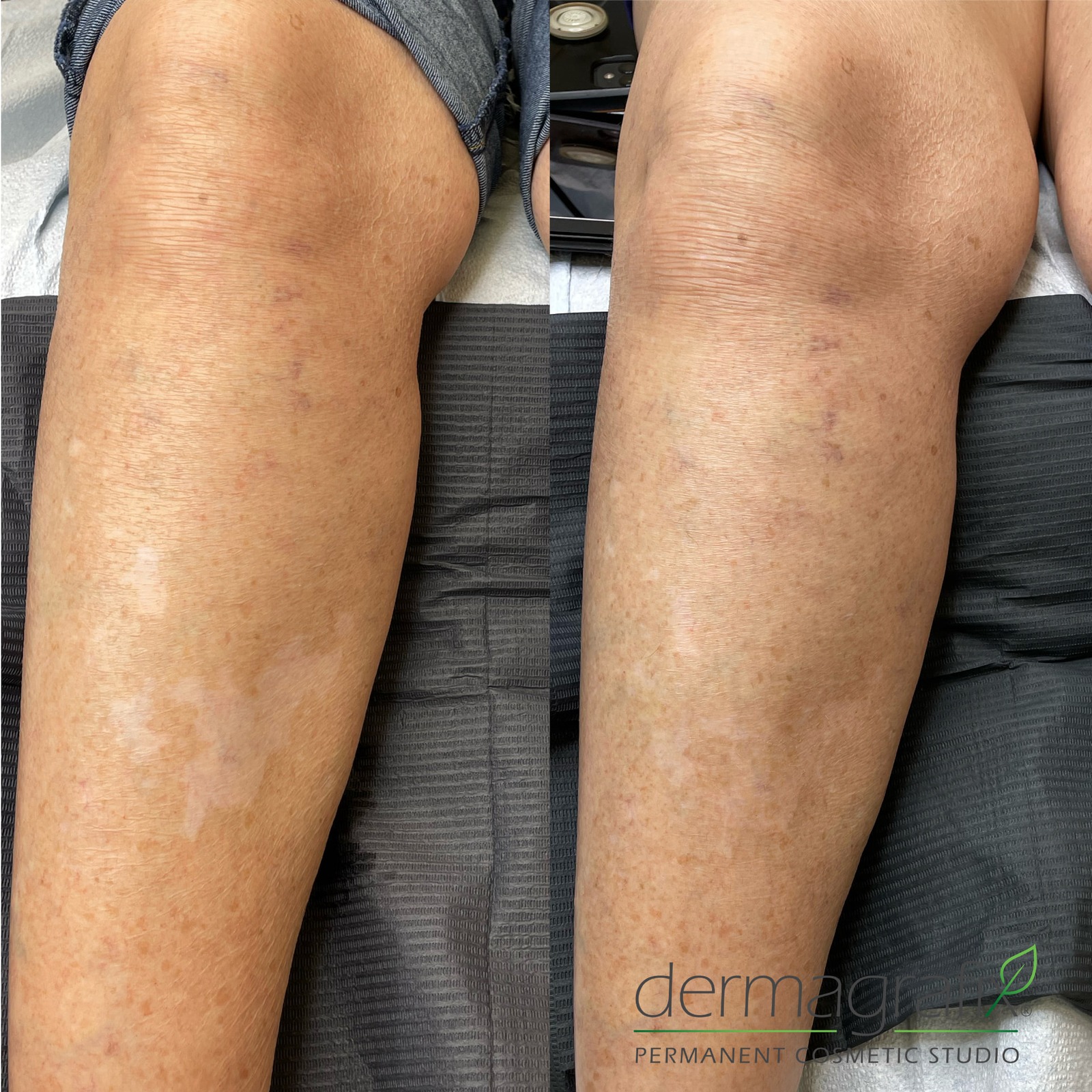
Most people searching for vitiligo help are looking for a medical treatment, and that conversation belongs with a dermatologist. This article is about a narrower question: if you have decided you want patches to be less visible, can they be covered, and what does that honestly involve?
First, you don't have to
Plenty of people with vitiligo want nothing changed, and that is a complete answer. We only do this work for people who want it for themselves — never because someone else suggested it.
What camouflage tattooing actually is
Pigment matched to your surrounding skin, layered into depigmented areas until the contrast drops. It is not a treatment: it does not restore melanocytes, it does not stop the condition, and it does not interact with medical therapy. It changes the appearance of the skin, nothing more. The difference between your own colour and placed colour is worth understanding — melanin vs. pigment.
Stability is the gate
Active vitiligo is not a candidate. A new patch appearing next to freshly matched skin undoes the work, and needling into skin can itself provoke spread — the Koebner phenomenon. We ask that your condition has been stable for a meaningful period and that your dermatologist is aware of the plan.
Why we spot test
A small paid test in a discreet area, then several weeks of waiting. It tells us how your skin holds the pigment, how the colour heals, and whether the area reacts at all. On a large region such as the hands, legs or chest, that patience is what separates a good result from a costly mistake.
What a healed result looks like
Reduced contrast, blended edges, and skin that reads as one tone at conversational distance. Close up and in strong light you may still see where the patches are. Colour also has to be matched to skin that tans: if the surrounding area darkens in summer and the matched area does not, the contrast returns seasonally. That is a real limitation, and we would rather you hear it now.
Sessions and cost
Multiple sessions, always — the work is layered and each layer has to heal before the next is judged. Our restorative work runs $399 to $799 per session depending on the area, and large regions are planned in stages. See pricing in full.
If you decide to look into it
A consultation is a conversation, not a commitment. We are in Bucks County and the Philadelphia area and on the Treasure Coast and Palm Beach coast, and the first visit can be virtual.
Read more about camouflage and repigmentation and healed results, or see healed results from real clients.
Pennsylvania
Our Doylestown studio welcomes clients from Bucks County, Montgomery County, Philadelphia and the greater Philadelphia area. See restorative tattooing and SMP near Philadelphia.
Florida
Our Stuart, FL studio welcomes clients from the Treasure Coast and Palm Beach coast, including Palm City, Jensen Beach, Port St. Lucie, Tradition, Hobe Sound, Jupiter, Tequesta and Palm Beach. See restorative tattooing and SMP on the Treasure Coast.